
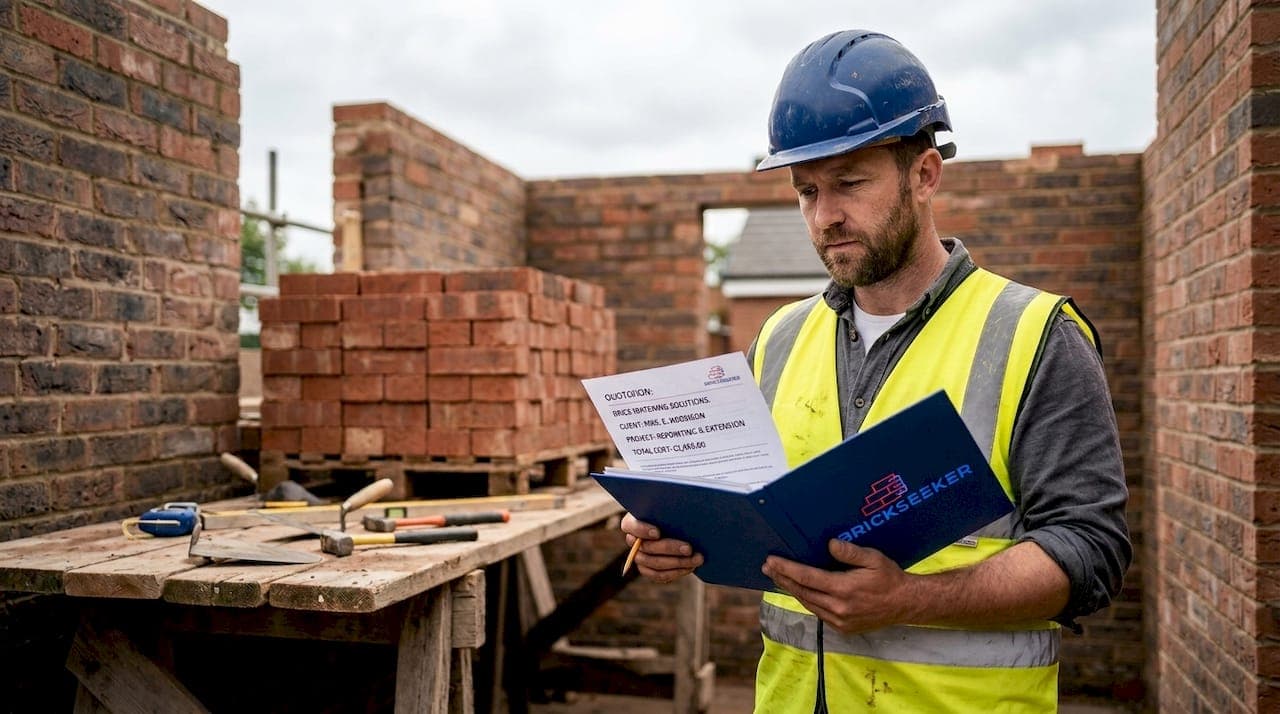
An accurate brickwork job quote in the UK is defined as a written document that itemises labour costs, material costs, exclusions, start and completion dates, a payment schedule, VAT status, and proof of insurance. Without every one of those components, you cannot make a reliable comparison between contractors, and your budget will be built on guesswork. Whether you are extending a Victorian terrace in Reading or building a garden wall in Newbury, the quoting process follows the same professional standard. This guide walks you through exactly how to request, read, and compare brickwork estimates so you can commission work with confidence.
What information do you need to provide to get an accurate brickwork quote?
The quality of a quote is directly proportional to the quality of the brief you provide. Contractors who receive vague instructions produce vague prices, and vague prices lead to variations mid-project.
Before approaching any bricklayer or contractor, prepare the following:
- Dimensioned drawings or sketches. Even a hand-drawn plan with accurate measurements is far more useful than a verbal description. Include wall heights, lengths, and any openings such as windows, doors, or gate piers.
- Materials specification. State whether you want machine-made facing bricks, hand-made bricks, or reclaimed stock. If you are matching an existing wall, note the colour, texture, and format. If you are unsure, Brickseeker's brick matching service can identify your existing brick from a photo before you even speak to a contractor.
- Access and site conditions. Is there vehicle access for deliveries? Is scaffolding likely to be needed? Are there any restrictions on working hours?
- Timeline. State your preferred start date and any hard deadlines. This allows contractors to flag material lead times upfront rather than after you have signed a contract.
- Consistent briefing. Send the same written brief to every contractor you approach. If each contractor is pricing a slightly different job, the quotes are incomparable.
Use Brickseeker's free brick calculator to estimate the quantity of bricks your project requires before requesting quotes. Knowing your approximate brick count gives you a useful cross-reference when reviewing what each contractor has allowed.
Pro Tip: Ask each contractor to confirm in writing that they have priced from your brief, not from their own assumptions. This single step eliminates the most common source of quote variation.
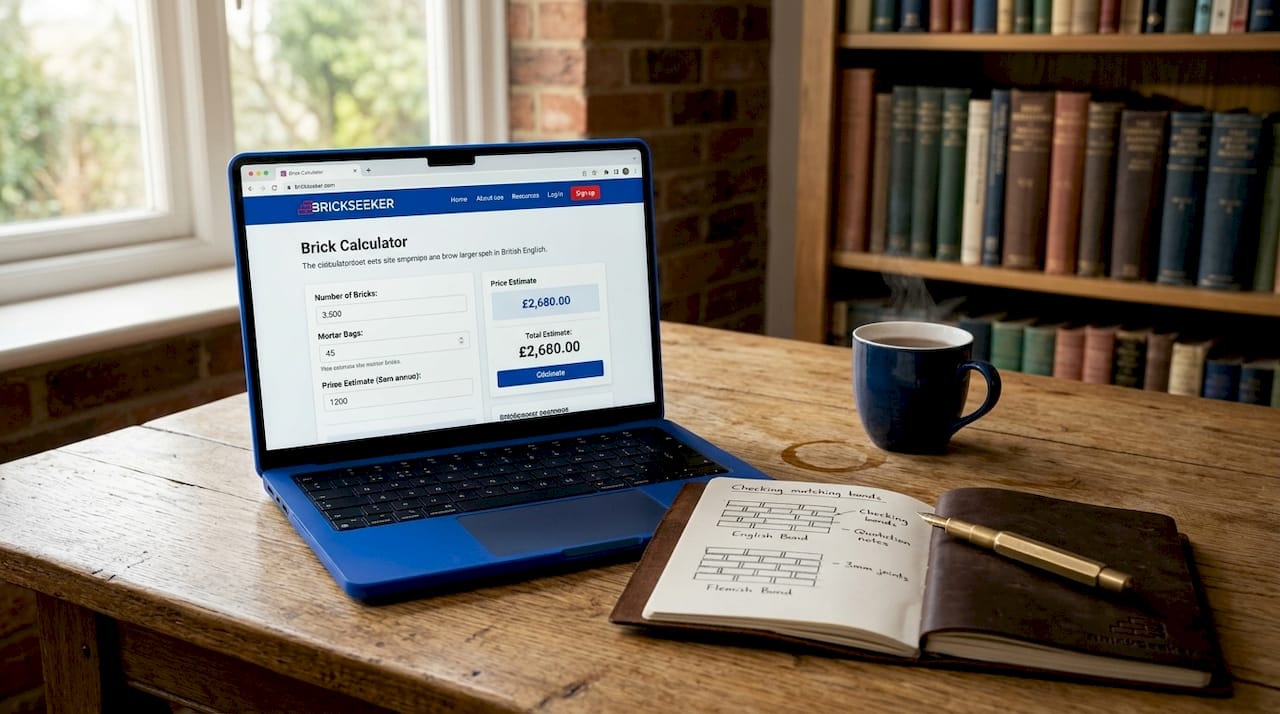
How to interpret and compare brickwork quotes accurately
Receiving three quotes and picking the middle one is not a comparison. It is a coin toss dressed up as due diligence. Meaningful comparison requires you to break each quote down to the same unit of measurement and check every line.
Follow this process:
- Convert all prices to a common unit. Normalise quotes to per m² or per 1,000 bricks, including skin count and waste allowances. A quote that looks cheaper in total may simply be pricing fewer bricks.
- Separate labour from materials. Lump sum pricing hides the real cost structure. Ask any contractor who has submitted a single figure to break it into labour, materials, and preliminaries.
- Check VAT treatment. VAT must be stated as inclusive or exclusive. At 20% for most building work by VAT-registered UK contractors, a quote that excludes VAT is effectively 20% more expensive than it appears.
- List every inclusion and exclusion. Place the three quotes side by side and mark what each one covers. Scaffolding, skip hire, DPC installation, cavity insulation, lintels, and building control fees are frequently omitted from quotes, turning a competitive headline price into a costly surprise.
- Check the validity period. Builder quotes are commonly valid for 30 to 90 days. A quote with no validity period gives the contractor room to revise pricing after you have committed.
- Verify start and completion dates. A quote without dates is a price, not a programme. Dates matter because material lead times, particularly for premium or reclaimed bricks, can run to six weeks or more.
- Confirm payment schedule. Stage payments tied to measurable milestones are standard practice. Any request for more than a modest deposit before work begins is a warning sign.
| Item to check | What to look for |
|---|---|
| VAT status | Clearly stated as inclusive or exclusive on every quote |
| Preliminaries | Scaffolding, skips, and site fees listed or explicitly excluded |
| Brick quantity | Stated in number of bricks or m², with waste allowance noted |
| Payment terms | Stage payments linked to progress milestones, not arbitrary dates |
| Validity period | 30 to 90 days from issue date |
Pro Tip: Create a simple spreadsheet with each contractor across the top and every line item down the side. Fill in the blanks, including zeros where items are missing. The gaps tell you more than the totals.
How much does brickwork cost in the UK?
UK brickwork pricing in 2026 splits into two distinct components: labour and materials. Understanding both separately is the only way to sanity-check a quote.
Labour rates
Typical bricklayer day rates run from £180 to £300, rising to £250 to £400 per day when a labourer is included. Total wall build costs range from approximately £150 to £300 per m², depending on brick type, bond pattern, and project complexity. London and the South East attract a premium of roughly 15 to 25% above the national average. Intricate work such as curved walls, decorative detailing, or arched openings takes longer per m² and should be priced accordingly.
Material costs
Brick prices vary considerably by specification:
- Basic machine-made bricks: £350 to £550 per 1,000
- Mid-range facing bricks: £550 to £850 per 1,000
- Premium hand-made bricks: £900 to £1,800 per 1,000
- Specialist or reclaimed bricks: £2,000 or more per 1,000
These are trade prices. Retail or small-quantity purchases will sit at the higher end. If your project requires matching an existing property, sourcing the correct brick is not optional. A mismatched brick on a finished wall is a problem that never goes away. See Brickseeker's 2026 UK brick cost guide for a full breakdown by brick type.
A quote that comes in more than 15 to 20% below the others for the same scope is not a bargain. It is almost always a sign that items are missing, quantities are underestimated, or the contractor intends to recover margin through variations once work is underway.
What are the most common pitfalls in brickwork quotes?
The most expensive mistakes in brickwork projects are not made on site. They are made at the quoting stage, when vague language and missing information are allowed to pass unchallenged.
Watch out for these specific problems:
- Vague scope language. Phrases like "works as discussed" or "brickwork to match existing" are not a scope of works. They are an invitation to dispute. Every element of the job must be described in writing.
- Missing exclusions. Masonry package quotes must explicitly state whether DPC, cavity insulation, lintels, building control, and scaffolding are included or excluded. Assume nothing.
- Excessive upfront payments. A deposit of 10 to 20% is reasonable. Requests for 50% or more before a single brick is laid suggest cash flow problems on the contractor's side.
- No insurance details. Any reputable contractor carries public liability insurance. Ask for the certificate before signing anything.
- Ignoring material lead times. Premium bricks can carry lead times of six weeks or more. If this is not factored into the programme, your project will stall mid-build.
- Choosing on price alone. The cheapest quote is rarely the best value. A contractor who has missed scaffolding, building control, and waste disposal from their price will recover those costs one way or another.
Pro Tip: Always request a formal written quote, not an estimate. A quote is a fixed price offer. An estimate is not. The distinction has legal weight if a dispute arises.
Step-by-step process to request, evaluate, and select the best brickwork quote
A structured approach removes emotion from the decision and gives you a defensible basis for contractor selection.
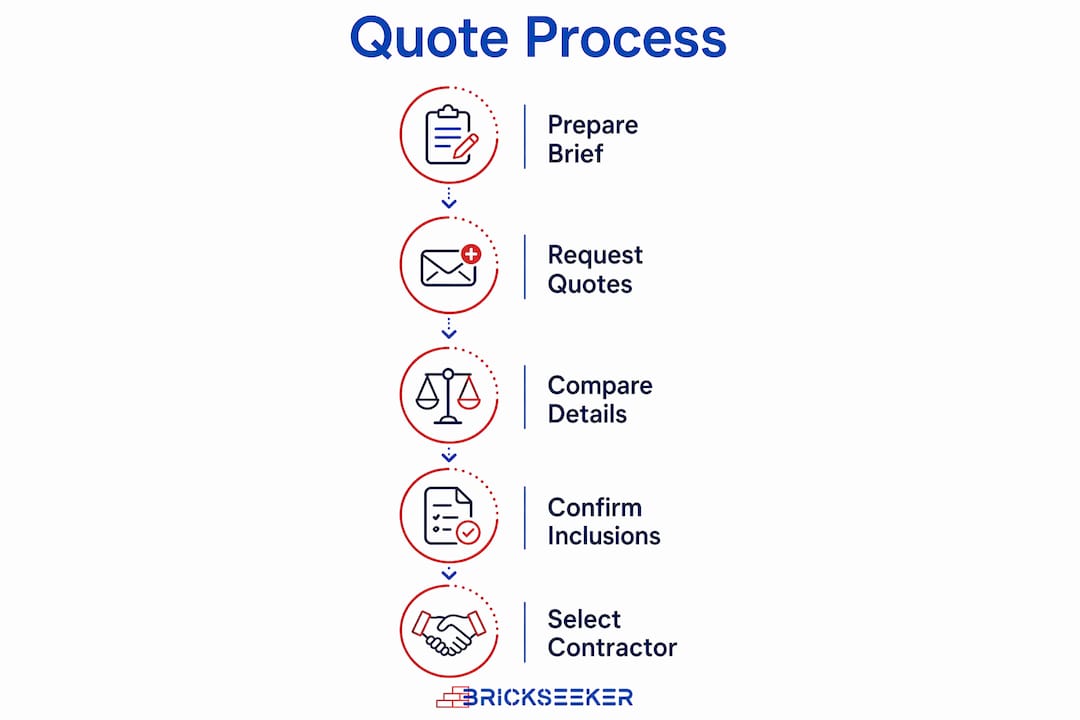
- Prepare a written brief. Include dimensioned drawings, materials specification, access details, and your preferred timeline. Send the identical brief to every contractor.
- Obtain at least three written quotes. Three quotes give you a meaningful range. Fewer than three and you have no benchmark.
- Verify each quote is complete. Use the checklist from the comparison section above. A quote missing VAT status, exclusions, or a payment schedule is incomplete and should be returned for revision.
- Benchmark against 2026 cost guides. Cross-reference labour rates and material costs against published guides. Brickseeker's UK brick market overview covers current supply conditions and pricing trends.
- Check references and insurance. Ask each contractor for two recent references from comparable projects. Call them. Verify that public liability insurance is current.
- Clarify variations procedure. Agree in writing how changes to scope will be priced and approved. Verbal agreements on variations are the single biggest source of end-of-project disputes.
- Confirm start date and programme. Once you select a contractor, get the start date and key milestones in writing before paying any deposit.
| Stage | Action |
|---|---|
| Before quoting | Prepare brief, drawings, and materials spec |
| Quote receipt | Check for VAT, exclusions, payment terms, and validity |
| Comparison | Normalise to per m² or per 1,000 bricks; build comparison spreadsheet |
| Due diligence | Verify references, insurance, and company registration |
| Contract | Agree scope, programme, variation procedure, and payment milestones in writing |
My honest view on getting fair brickwork quotes
By Richard
The single biggest mistake I see homeowners make is treating a brickwork quote like a supermarket price tag. They look at the total, pick the one that feels right, and move on. The problem is that two quotes for "the same job" can be priced on entirely different assumptions about what the job actually includes.
The fix is not complicated, but it does require discipline. Accurate estimating depends on clearly defined scope and version-controlled documents. That means your brief must be fixed before you approach anyone. If you change the spec after quotes are in, you are comparing apples with oranges.
I also think the industry undersells the value of splitting costs into components: bricks and blocks supply, mortar and fixings, and labour output. When you budget this way internally, you can immediately spot whether a contractor has allowed a realistic brick price or has used a placeholder that will blow out when they actually source the material. It takes an extra hour, but it has saved more than one project from a nasty mid-build conversation.
Finally, do not underestimate material lead times. A contractor who quotes a four-week programme without checking availability on your specified brick is not being optimistic. They are being careless. Long lead times must be communicated upfront to maintain cost and schedule certainty. If your brick is six weeks out, your programme needs to reflect that from day one.
— Richard
Get the right brick before you finalise your quote
One element that regularly derails brickwork budgets is the material specification. If you are extending, repairing, or matching an existing wall, the brick you choose affects both the cost and the lead time in your quote. Brickseeker is a UK specialist brick matching and sourcing service. Send us a photo or a physical sample and our team will identify your brick, source it from our UK-wide supplier network, and confirm availability before your contractor finalises their price. No minimum orders, no trade account needed. Getting the material specification right at the quoting stage means no surprises once work begins. Visit Brickseeker's brick matching service or message us on WhatsApp for a fast response.
FAQ
What must a brickwork quote include in the UK?
An accurate brickwork quote must include a detailed scope of works, itemised labour and materials, a list of exclusions, start and completion dates, a payment schedule, VAT status, and proof of insurance. Without these components, meaningful comparison between contractors is not possible.
How much does brickwork cost per m² in the UK in 2026?
Total wall build costs typically range from £150 to £300 per m², depending on brick specification, bond pattern, and regional location. London and the South East sit at the higher end of that range.
How do I compare brickwork quotes fairly?
Normalise all quotes to the same unit, either per m² or per 1,000 bricks, and check that each quote covers identical inclusions and exclusions. A quote that appears cheaper may simply be omitting scaffolding, building control fees, or waste disposal.
Should I be concerned if one quote is much lower than the others?
A quote more than 15 to 20% below the others for the same scope almost always indicates missing items, underestimated quantities, or an intention to recover costs through variations. It is not a sign of a better deal.
How long is a builder's quote valid for in the UK?
Most builder quotes are valid for 30 to 90 days from the date of issue. A quote with no stated validity period gives the contractor room to revise pricing before you formally accept, which creates unnecessary risk for your budget.
Key takeaways
Accurate brickwork quotes require itemised scope, normalised measurements, and verified inclusions before any contractor is selected.
| Point | Details |
|---|---|
| Itemise every component | Separate labour, materials, and preliminaries to reveal the true cost structure of each quote. |
| Normalise before comparing | Convert all quotes to per m² or per 1,000 bricks to make genuine like-for-like comparison possible. |
| Check VAT and exclusions | VAT at 20% and missing preliminaries like scaffolding can add thousands to a headline price. |
| Treat low quotes with caution | Quotes more than 15 to 20% below average typically hide missing items or underestimated quantities. |
| Confirm material lead times | Premium or reclaimed bricks can take six weeks or more to source, affecting programme and cost certainty. |